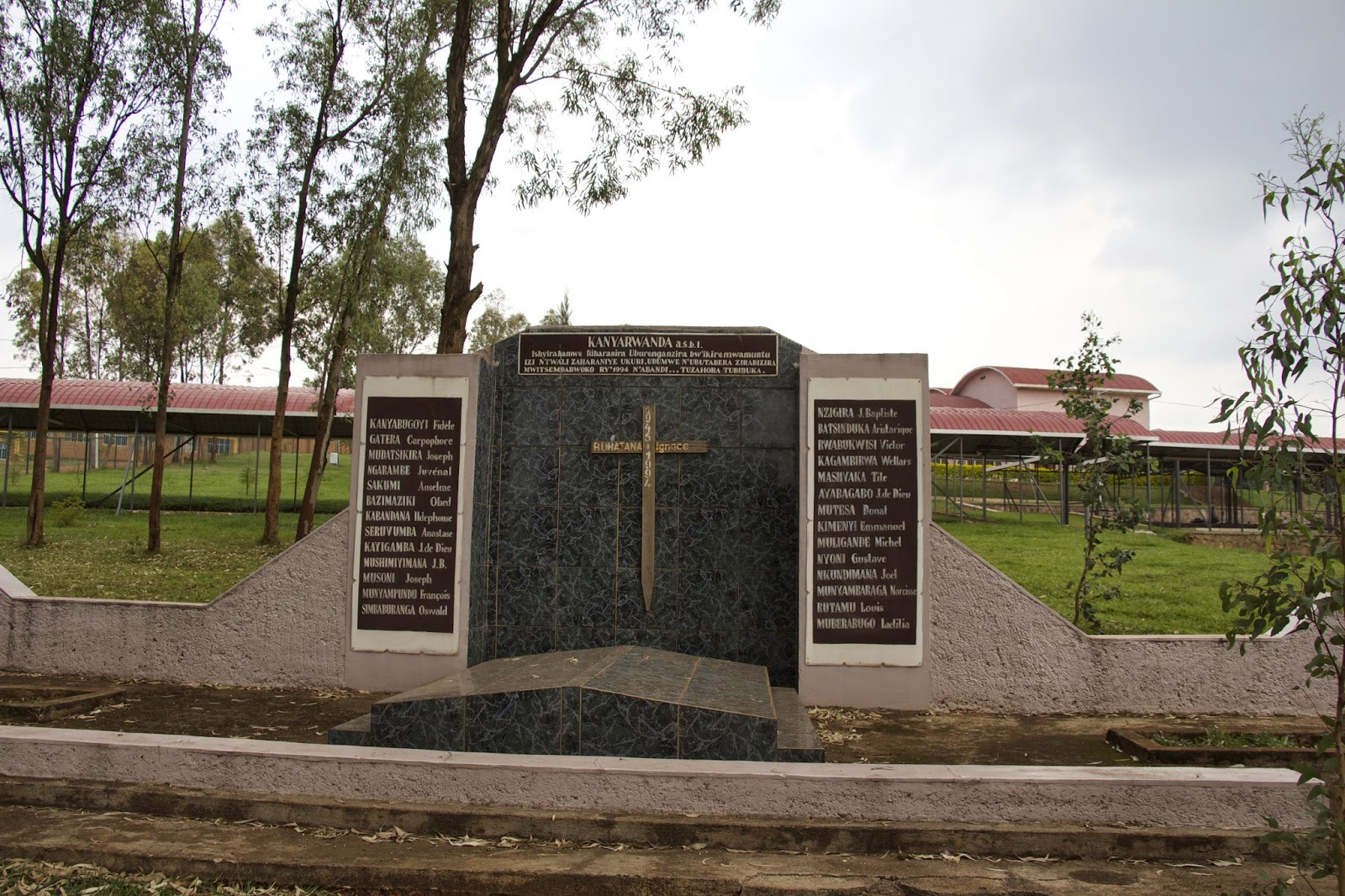
After a decent night's sleep, though a little shorter than I would have liked, I grabbed some breakfast and rushed around to make sure I wasn't late for our tours today (I haven't been late yet, but I'd like not to be "that person"). We left around 9am and headed 45 minutes away to the Murambi Memorial. When you get about 2.5km away from the memorial you can see it perched on top of the next small hill. After a bumpy dirty road ride to the gates we got out and began our walk up the path. The cite of this massacre was chosen because it sat between many high hills, allowing militias to see anyone trying to escape. Tutsis were told to go there and hide to be safe, but it was all a plan by the Hutu militias to collect the local Tutsis in one place. There was a small tiki torch in a glass case as part of the torch ceremony in the country, presumably where they placed one at each genocide memorial, finally lighting the large torch in Kigali for the 20 year anniversary of the genocide. We approached the front and were met by our guide. He greeted us and showed us the way into the museum part of the memorial. The walls were filled with the timelines of the genocide, testimony, and many pictures of victims. It appeared that either someone had broken in recently and stolen all of the projectors, or they had removed all of the projectors for some unknown reason. The TVs for informational videos did not work and every projector, and floor-mounted screen were missing. Even though parts were missing, the museum was incredibly well put together and provided some good background, as well as a section dedicated to those that sheltered Tutsis, thus risking their lives in the process. Following the museum section we went outside and visited the mass graves. When we got there we all participated in a moment of silence, and a Rwandan man that was taking the tour with us offered to say a prayer in Kinyarwanda, which was a humbling experience to witness. The mass graves are left in a way that allows the top to be opened up so as more bodies are found, even 20 years later, they can be laid to rest with the others.
From the mass grave we walked around the main building and saw a series of small buildings, meant to originally act as housing for the students that were supposed to go to school there. Now the buildings sit in disrepair, no windows, few doors, and bars over the open windows. Once we got to the rear of the complex of buildings we were told that we were going to see preserved bodies of victims that had been removed from mass graves farther in the back of the complex, and had been treated with lime to, essentially, mummify them. The first two rooms consisted of both male and female bodies, preserved and laid out on raised wooden racks. The bodies were contorted, some having not been killed before they were thrown in the mass graves were in defensive positions where they died, trying to suffocate under other dead Rwandans. Some were captured in their final position, begging to be spared. Many of the corpses were flattened due to the weight of the bodies above and the heat from decomposition. The following rooms were separated by groups such as women, children, women that were raped, and women with their children. Every room had the same sickeningly sweet smell, kind of like you hear described in books about death and murder. We were told that we would have had to write to a government agency to get permission to take pictures of the bodies, but at the end the guide informed us that he would allow us to take a couple of pictures since we didn't know and had come all that way. So we took a few pictures, though I did feel a little bit uncomfortable taking pictures of the dead, I knew that if I didn't, I would want to have them to show others within my program, and when I give presentations on my trip.
From there we walked around back where we saw the spot that the French troops had their flag during "Operation Turquoise."Billed as a humanitarian mission to the U.N., French troops entered Rwanda to defend what remained of the Hutu extremist regime. Claiming to provide protection, many of those they gathered up to protect, were left for a day and when the French returned, the Hutus had killed all of those they had saved. During the tour, the guide explained that not only did the French protect the old government, but they also shot Tutsis that had been brought to them for protection. Additionally the troops put men and women that were still alive in bags that held their legs and arms together, loaded them into helicopters, and dropped them from thousands of feet in the air into the middle of the forests to the east. Additionally, the French built a volleyball court on top of a mass grave. Here they celebrated, partied, and drank above the bodies of those recently murdered.
So I had it all written out a 2nd time and it had another issue, so I'll be super brief because I've written the story out twice and it has failed to upload. So our guide told us that he and his brother are survivors of the gencide. We were very shocked about this and he told us the story of how he survived.
Below you will see pictures from today. A little warning, some of the pictures are graphic and while I feel that they are imporant for others too view, they may be too graphic for others.
 |
| We LOVE Rwanda!!! |
 |
| Murabi as seen from an adjacent hill. It can be viewed from all sides |
 |
| Standing at the gate |
 |
| Signs on the front of the memorial for the 20 year anniversary of the genocide |
 |
| Female rape victims of the 1994 Rwandan Genocide |
 |
| Female victims of the 1994 Rwandan Genocide |
 |
| Area that the French built a volleyball court on a mass grave |
 |
| Mass grave that has been emptied of bodies, but left open to show the scale. There were 5 of these on the property |
 |
| Me with our guide and genocide survivor. Amazing to meet such an amazing man, and have him explain what it was like |