Showing posts with label Car Ride. Show all posts

Wednesday, June 18, 2014

Day 18 & 19: Coming Full Circle and the Long Road Home

Hey all! Sorry for the delay in my final 2 days of postings. Between running around and seeing the sites we missed our first time in Kigali, shopping for more stuff to bring home, and trying to pack all that stuff, it just wasn't possible to blog. Now I'm well rested and have fast internet, so I can post about my last day and a half in Rwanda.

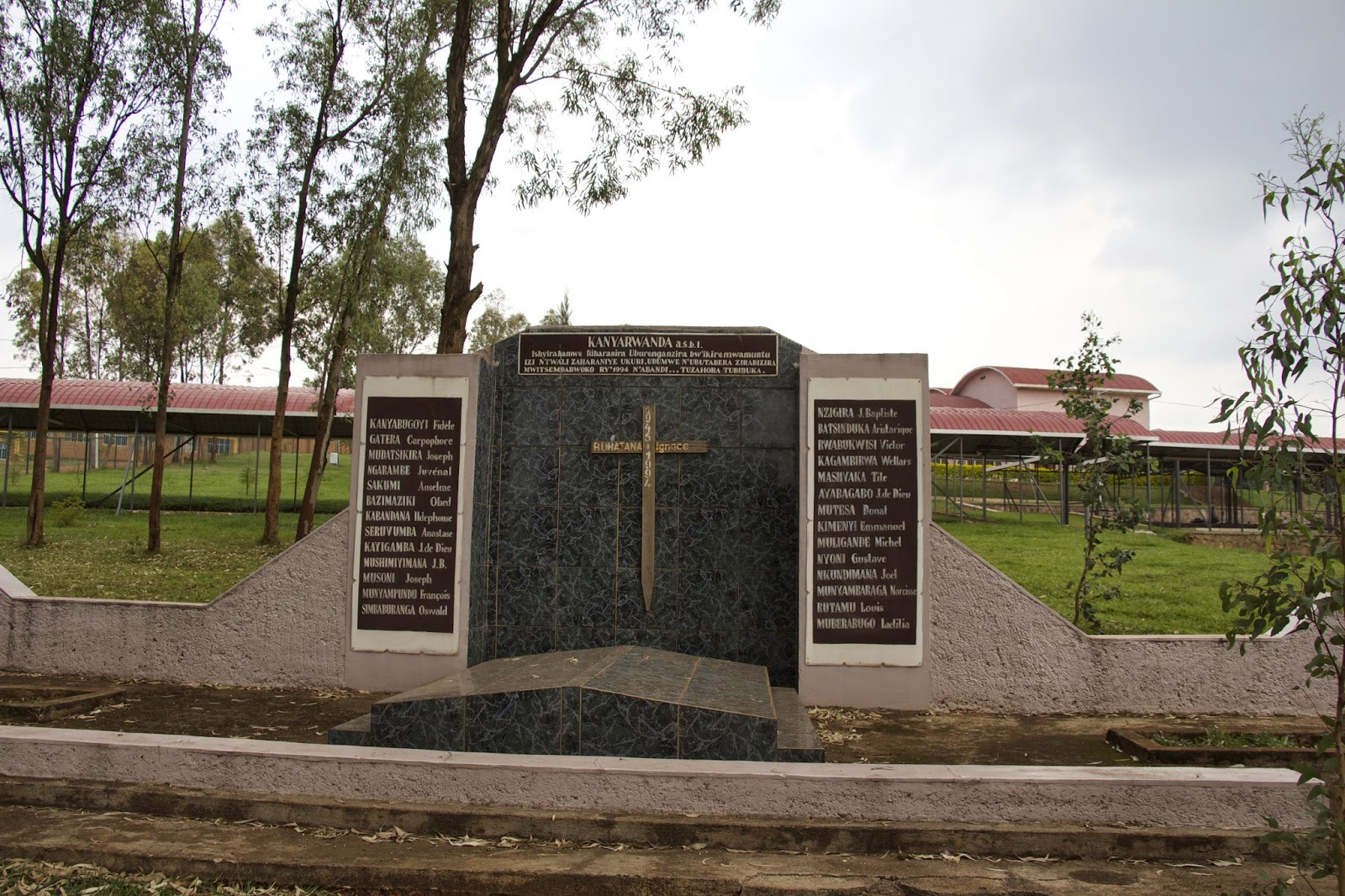
So we all got up and had some breakfast at the guest house in Musanze and left the guest house by 10am. From there it was a short, paved, 2 hour drive down to Kigali. Once we were there we went to the hotel, grabbed some lunch and then split up. Previously we had missed a planned memorial visit so Dr. Gaydosh and I took one driver to that memorial while everyone else went shopping. Unfortunately it was a Sunday, so most stuff was closed. They couldn't get us into the main building, but after some "persuasion" the well armed police officer took us for a walk through the outside part of the memorial. There are some pictures below to give you an idea of the memorial. On the way back into town we stopped the an infamous ETO school, which is still used as a school today, but was the site of a UN base that house refugees, until the UN pulled out, leaving the refugees to be massacred. Below there is a picture that has the signage, which should provide a good idea of what happened. It was a little weird taking pictures there because it is an active university. Students came up and translated to the guard what I wanted to do, and they guard let me in, but the students looked unhappy that I wanted to take pictures, which is the first time during the whole trip that I felt unwelcome at a genocide site. 

From there we went back to the Kigali Memorial Museum to find out if we could buy 20 year anniversary banners from anyone. The guy there put us in contact with a man who said he could make them. I wanted one for myself and to use when I go and lecture, and Dr. Gaydosh wanted one for the HGS room. It will be interesting to see if in 20 years where the country is, and if the banner still resides in that room. 

The following day we went ran around and packed and then waited at the airport for the banner guy to come drop them off. Luckily he showed up in the middle of a rain storm and gave us the banners minutes before we needed to board our flight. From there it was over 20 hours of travel to get back to the U.S. Coach wasn't bad, and Bethany and I kept each other entertained on the trip, laughing many times at things that were probably only funny to us. Once we got back I forced myself to stay awake and then finally passed out around 10. I plan in a few days to write a reflective post on my impressions, etc. now that I'm back in the states, but wanted to finish off the actual day to day part of the blog first. Below are pictures of the memorial and the school.


Thursday, June 12, 2014

Day 15: Boats, Cars, and Volcanoes

Today we got up early and had the most amazing breakfast. Sitting on the lake shore the workers brought out our food by the truckload. We ate it fast because we had another boat ride to catch. We rode out onto lake Kivu and stopped on a micro island for a group picture. From there we went to a natural hot spring where we were greeted by children that folks is by the hand to the spring. Once we got there the children each took a hand, rinsed it. Following the rinse they took leaves from nearby plants and used them to scrub our hands and then rinsed them again. After that we got back on the boat and went back to the hotel. We loaded up and hit the road. The workers at the hotel were awesome and sent us on our way with a surprise doughnut wrapped in a banana leaf. 

Along our way to our next town we stopped at a former orphanage, made famous from Gorillas In the Mist (where Sigourney Weaver goes to write her letter of resignation) and we got a tour. We also got to see more dancing, something the original owner enjoyed every Sunday. I got to go up and join the drummers, which as a former drum line member was awesome. From there we heard out to the next town near volcanoes national park. We stopped at a twa village after lunch and they sang and danced. We got to meet these people and have discussions with them about their life and culture. From there we did some more shopping and then dinner. Soon we will go back to our rustic hotel and hopefully get a good night of sleep. I'll add a couple pictures now, using my phone app, and I'll try to add more later. There isn't wifi at the hotel, so I'm probably going to use my phone for the last days here. 


Tuesday, June 10, 2014

Day 13: Travel and the Bisesero Genocide Memorial

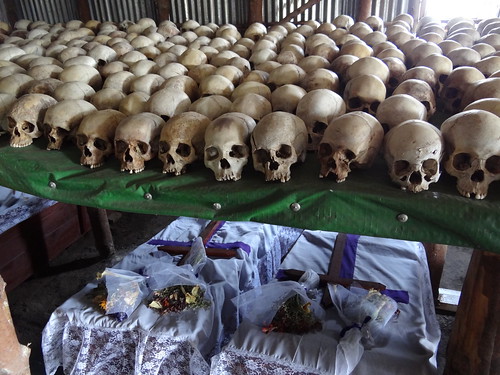
Today was a long day. We got up early and left the hotel by 8am. After about an hour of driving on the highway the paved road ended and we spend several hours bouncing around the car on some wicked dirt roads. The views were amazing though. About 3.5 hours into the drive we stopped at the Bisesero Genocide Memorial which is currently under construction to see what was there. We were able to see the areas they had built, but not filled with anything, along with a  memorial to those that fought back against their murderers. The people, about 50,000 of them all hid there where men with spears stood guard to help protect. However, they were not able to hold off all of the murderers that had guns, grenades, and many hand weapons. Some survived the first wave of attacks, but the French arrived, and told them that they would arrange transport into a safe zone for them. The French then left to arrange transport, and when they left, the murderers returned and killed all of the remaining people, who thought they were under French protection. We were taken down to tin shed and inside was the skulls and bones of 1,040 victims. Below were coffins filled with as many as 50 people’s skeletons each. The plan is to move all of the remains into a permanent location where visitors can see the remains of all 50,000 victims. From there we drove a few more hours, getting lost part way, to our hotel which is right on lake Kivu. It is beautiful, and I’m sad that we are only here tonight, and leave in the morning. Below are pictures from the memorial.  I look forward to posting tomorrow!

The pictures of the bones in the genocide are not mine, but ones I found online. When we got there they said the government has to give permission for us to take pictures, and we didn’t know this in advance. But I wanted everyone to see what we saw today.


Friday, June 6, 2014

Day 9: Butare, Lessons in the Ethnogram


Today was a very short day in terms of things we saw. I also have to be very brief because I need to go to bed very soon. We have to leave the hotel at 5am sharp so we can get to the forest and start tracking the Chimpanzees. So we got up in the morning and ate breakfast. Then we loaded up the car so we were ready to leave as soon as we were done with our activity for the day. We went back to the campus and practiced our observation skills with the vervet monkeys. It was really cool. I have never had a chance to do something like this, and it was great to learn how it is done. I wasn’t sure what would happen, or what to expect, but everyone was really nice and took the time to explain to me how it worked and what to look for. So we followed the vervets around and noted their behaviors, social interactions, etc. We did that for about 30-45 minutes after a brief explanation and Q&A with Dr. Rundus. On our way out we stopped on campus at their genocide memorial for the students and faculty of the university that were killed in the 1994 genocide. They have what appears to be a grave as well as large boards with pictures of the students and faculty they lost in the genocide. Following that brief visit, we stopped at a co-op for some more shopping. Lots of fun things to take home were purchased. Then on to one more amazing lunch in Butare before we hit the road. It was a 3 hour ride through the country and one of the national forests. The roads were very curvy and many were one lane and many times we all made noises of surprise when we would come around a corner and a mac truck would be barreling down the middle of the road towards us. We made it safe and sound to possibly the largest, and nicest hotel ever. Compared it America it could use some upgrades, but it is massive! It has a livingroom and there are two twin bedrooms that each have their own bathroom. We were told our suite is where the president stays when he is in the area. Ok, well I have to head off to bed, I’m sure I’ll get a chance tomorrow after the chimps to blog some more. Goodnight!

P.S. I got an email from the student I met yesterday and he informed me that his final project for his undergraduate degree has been approved, and that he dedicated it to me, including pictures of me and him at the very end of it. It was very nice to hear that he was successful, and I was touched that he felt compelled to dedicate his undergraduate “memoir” or thesis, to me. So many amazing people here!


Mother with baby walking about 5-10 feet from me.

A pull off in the national forest. Words cannot describe how amazing it was.

Tuesday, June 3, 2014

Day 6: Murambi Genocide Memorial & Butare Museum

After a decent night's sleep, though a little shorter than I would have liked, I grabbed some breakfast and rushed around to make sure I wasn't late for our tours today (I haven't been late yet, but I'd like not to be "that person").  We left around 9am and headed 45 minutes away to the Murambi Memorial. When you get about 2.5km away from the memorial you can see it perched on top of the next small hill. After a bumpy dirty road ride to the gates we got out and began our walk up the path. The cite of this massacre was chosen because it sat between many high hills, allowing militias to see anyone trying to escape. Tutsis were told to go there and hide to be safe, but it was all a plan by the Hutu militias to collect the local Tutsis in one place. There was a small tiki torch in a glass case as part of the torch ceremony in the country, presumably where they placed one at each genocide memorial, finally lighting the large torch in Kigali for the 20 year anniversary of the genocide. We approached the front and were met by our guide. He greeted us and showed us the way into the museum part of the memorial. The walls were filled with the timelines of the genocide, testimony, and many pictures of victims. It appeared that either someone had broken in recently and stolen all of the projectors, or they had removed all of the projectors for some unknown reason. The TVs for informational videos did not work and every projector, and floor-mounted screen were missing. Even though parts were missing, the museum was incredibly well put together and provided some good background, as well as a section dedicated to those that sheltered Tutsis, thus risking their lives in the process. Following the museum section we went outside and visited the mass graves. When we got there we all participated in a moment of silence, and a Rwandan man that was taking the tour with us offered to say a prayer in Kinyarwanda, which was a humbling experience to witness. The mass graves are left in a way that allows the top to be opened up so as more bodies are found, even 20 years later, they can be laid to rest with the others.

From the mass grave we walked around the main building and saw a series of small buildings, meant to originally act as housing for the students that were supposed to go to school there. Now the buildings sit in disrepair, no windows, few doors,  and bars over the open windows. Once we got to the rear of the complex of buildings we were told that we were going to see preserved bodies of victims that had been removed from mass graves farther in the back of the complex, and had been treated with lime to, essentially, mummify them. The first two rooms consisted of both male and female bodies, preserved and laid out on raised wooden racks. The bodies were contorted, some having not been killed before they were thrown in the mass graves were in defensive positions where they died, trying to suffocate under other dead Rwandans. Some were captured in their final position, begging to be spared. Many of the corpses were flattened due to the weight of the bodies above and the heat from decomposition. The following rooms were separated by groups such as women, children, women that were raped, and women with their children. Every room had the same sickeningly sweet smell, kind of like you hear described in books about death and murder. We were told that we would have had to write to a government agency to get permission to take pictures of the bodies, but at the end the guide informed us that he would allow us to take a couple of pictures since we didn't know and had come all that way. So we took a few pictures, though I did feel a little bit uncomfortable taking pictures of the dead, I knew that if I didn't, I would want to have them to show others within my program, and when I give presentations on my trip.

From there we walked around back where we saw the spot that the French troops had their flag during "Operation Turquoise."Billed as a humanitarian mission to the U.N., French troops entered Rwanda to defend what remained of the Hutu extremist regime. Claiming to provide protection, many of those they gathered up to protect, were left for a day and when the French returned, the Hutus had killed all of those they had saved. During the tour, the guide explained that not only did the French protect the old government, but they also shot Tutsis that had been brought to them for  protection. Additionally the troops put men and women that were still alive in bags that held their legs and arms together, loaded them into helicopters, and dropped them from thousands of feet in the air into the middle of the forests to the east. Additionally, the French built a volleyball court on top of a mass grave. Here they celebrated, partied, and drank above the bodies of those recently murdered.

So I had it all written out a 2nd time and it had another issue, so I'll be super brief because I've written the story out twice and it has failed to upload. So our guide told us that he and his brother are survivors of the gencide. We were very shocked about this and he told us the story of how he survived.

Below you will see pictures from today. A little warning, some of the pictures are graphic and while I feel that they are imporant for others too view, they may be too graphic for others.

We LOVE Rwanda!!!

Murabi as seen from an adjacent hill. It can be viewed from all sides
Standing at the gate

Signs on the front of the memorial for the 20 year anniversary of the genocide
Female rape victims of the 1994 Rwandan Genocide

Female victims of the 1994 Rwandan Genocide

Area that the French built a volleyball court on a mass grave

Mass grave that has been emptied of bodies, but left open to show the scale. There were 5 of these on the property

Me with our guide and genocide survivor. Amazing to meet such an amazing man, and have him explain what it was like


Monday, June 2, 2014

Day 5: Traveling & Butare (now known as Huye)

Today was a pretty light day. We got up and had breakfast, I was excited to find country potatoes, bacon, ickynumero fresh fruit, and ickynumero jelly. It was a great way to end our time at Chez Lando. We left around 9, stopped by the supermarket for a snack (jelly doughnut) and some cold bottled water. From there it was about a 2.5 hour drive to Butare, recently renamed to Huye, where we stopped at the King's Palace. The palace is a recreation of the hut the king of Rwanda lived in until a colonial palace was built by the Germans in the mid to late 30s. The two now sit next to each other and provide a stark contrast of Rwandan society before and after colonization. The hut was really interesting and showed the section for women, the section for men, and the bed for the king and his woman of the night. The king had as many as 40 wives, but only one was the official queen mother. We also saw the milk hut, and beer hut. Additionally, we got to see the ceremonial cows. they have massive horns that are as long as my torso is tall. They are trained by the herder to come out and present itself based on wistles and certain songs. The man sang to the cow while we got to pet it. It was crazy to stand next to this massive cow with massive horns and pet it. Then we got to see the calves that were not very old, the youngest was almost 3 weeks old.  From there we went to the hotel, which was a slight downgrade in quality, but I'm sure there is far worse out there. So then we had an amazing dinner in town and back to hotel to enjoy the worst and tiniest shower I've ever seen. It was best summed up by another student's father who said you can sh*t, shower, and shave all at once because it is all so close and there is no shower curtain. Tomorrow will be busier and I'll probably have a longer blog as we will be going to a museum and a genocide memorial.

Traffic Congestion

Rwandan Jelly doughnut for the road

View from the road

View from the road

Guy catching a ride up the hill

People walking down the road

King's Hut

Cow dug furnace

Tasting Sorgum, used to make beer

Grinding sorgum to make beer

Ceremonial cow

Me with the ceremonial cow

Herder singing to the cow

3 week old baby cow

Colonial palace for the king

Rwandan Flag