Showing posts with label Kigali Genocide Memorial. Show all posts

Wednesday, June 18, 2014

Day 18 & 19: Coming Full Circle and the Long Road Home

Hey all! Sorry for the delay in my final 2 days of postings. Between running around and seeing the sites we missed our first time in Kigali, shopping for more stuff to bring home, and trying to pack all that stuff, it just wasn't possible to blog. Now I'm well rested and have fast internet, so I can post about my last day and a half in Rwanda.

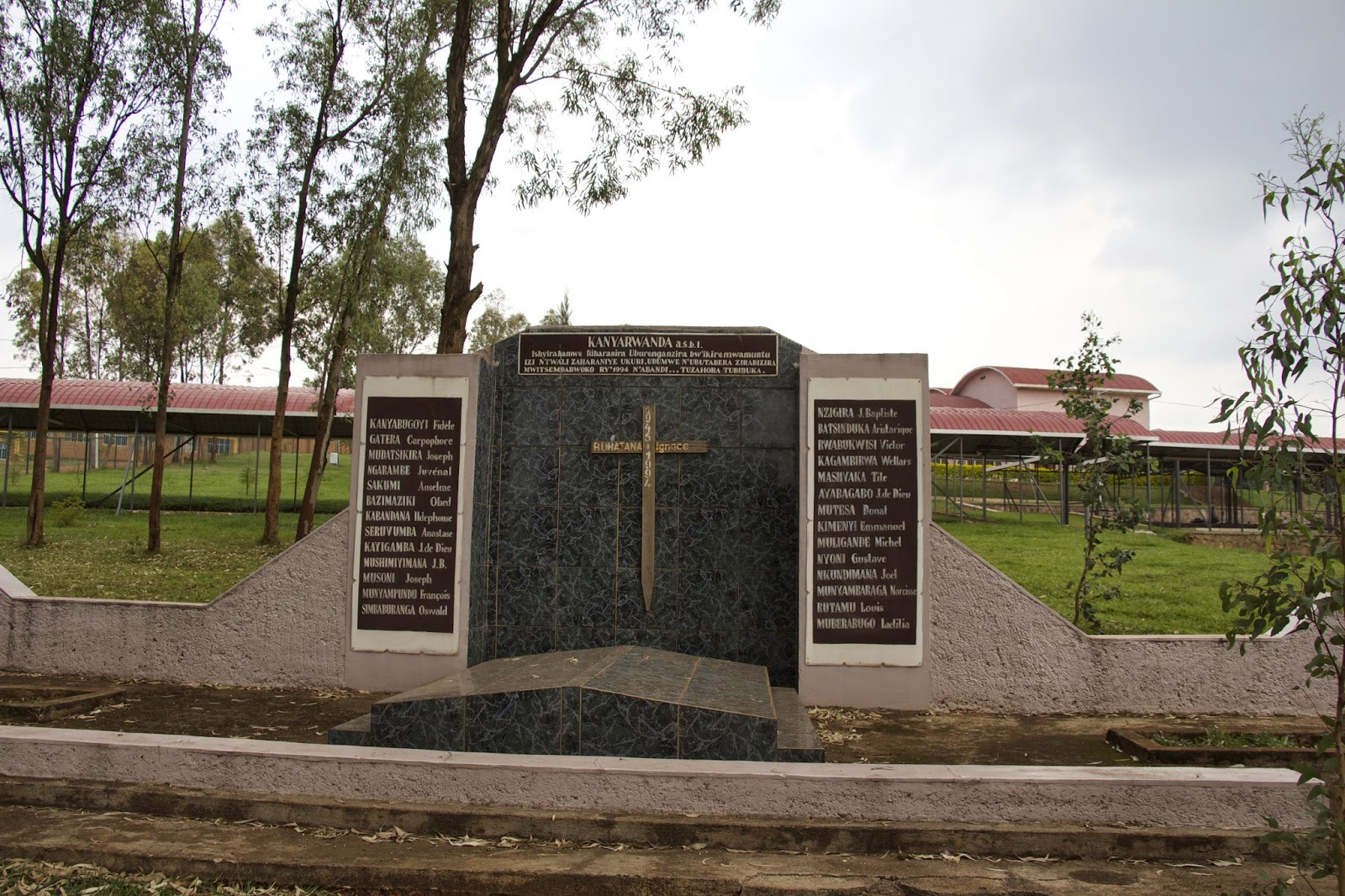
So we all got up and had some breakfast at the guest house in Musanze and left the guest house by 10am. From there it was a short, paved, 2 hour drive down to Kigali. Once we were there we went to the hotel, grabbed some lunch and then split up. Previously we had missed a planned memorial visit so Dr. Gaydosh and I took one driver to that memorial while everyone else went shopping. Unfortunately it was a Sunday, so most stuff was closed. They couldn't get us into the main building, but after some "persuasion" the well armed police officer took us for a walk through the outside part of the memorial. There are some pictures below to give you an idea of the memorial. On the way back into town we stopped the an infamous ETO school, which is still used as a school today, but was the site of a UN base that house refugees, until the UN pulled out, leaving the refugees to be massacred. Below there is a picture that has the signage, which should provide a good idea of what happened. It was a little weird taking pictures there because it is an active university. Students came up and translated to the guard what I wanted to do, and they guard let me in, but the students looked unhappy that I wanted to take pictures, which is the first time during the whole trip that I felt unwelcome at a genocide site. 

From there we went back to the Kigali Memorial Museum to find out if we could buy 20 year anniversary banners from anyone. The guy there put us in contact with a man who said he could make them. I wanted one for myself and to use when I go and lecture, and Dr. Gaydosh wanted one for the HGS room. It will be interesting to see if in 20 years where the country is, and if the banner still resides in that room. 

The following day we went ran around and packed and then waited at the airport for the banner guy to come drop them off. Luckily he showed up in the middle of a rain storm and gave us the banners minutes before we needed to board our flight. From there it was over 20 hours of travel to get back to the U.S. Coach wasn't bad, and Bethany and I kept each other entertained on the trip, laughing many times at things that were probably only funny to us. Once we got back I forced myself to stay awake and then finally passed out around 10. I plan in a few days to write a reflective post on my impressions, etc. now that I'm back in the states, but wanted to finish off the actual day to day part of the blog first. Below are pictures of the memorial and the school.




Saturday, May 31, 2014

Day 3: Umuganda & Kigali Genocide Memorial

Jetlag is awful! I went to bed last night around midnight and woke up wide awake at 1am. After forcing myself to go back to sleep I managed about 3 more hours of sleep. So today was a constant effort to stay awake. We got up and had some breakfast and then walked about 10 minutes to a suburb of Kigali to participate in that community's umuganda project. Umuganda is a mainly mandatory (those with money can buy their way out of it) monthly community service. Citizens cut grass, sweep roads, pick up trash, build various things,  etc. So we met up with a group of locals and they gave us machetes, a hoe, and something called a kopa kopa and is used for cutting grass by hand and cutting back large plants. Umuganda lasts around 3 hours, or 4 in our case. All of us chipped in and helped clear the side of a road so that the grass was very short etc. Then we walked up an incredibly steep hill that had us all panting for breath where we cleared the entire side of a road. It was a lot of hard work. Apparently most western tourists do not participate in this event, and neither do foreigners that work in the country. So the people of the village were very surprised to see a large group of white people coming to help. We met so many nice people, but it was amusing to be hacking away at some bushes in the 80 degree hot sun and turn around and see 20 townspeople staring at you. When they realized that you noticed they would jump and laugh a little. It didn't bother me at all, once they got to know each of us they were very interested in what we do and what it is like for us in America, etc. We made several friends during the service and the town hall meeting afterwards. Following the community service everyone there gathered on the hillside and they had a town meeting where they discussed a variety of topics from paying taxes, reinforcing the idea that there are no tribes in Rwanda anymore, and even discussing a guy that is having many women live in his house and they sneak out at night, and what should be done about it. It was very interesting to witness. Some of the people sitting with us were nice enough to translate what was going on so we could follow along. 

After umuganda we went to the hotel for a shower and some lunch. After we did that Dr. Rundus was lucky enough for his missing baggage to arrive on a flight into Kigali, after the company had no idea where they could be. He was very happy to have clean clothes for the first time in multiple days. 

Following lunch we went and visited the Kigali Genocide Memorial & Museum. It was a really interesting setup. Outside you can see mass graves that hold the bodies of about 250,000 victims from the Kigali area. There was also a number of special gardens, each symbolizing a different thing. One was for the early days of Rwanda when times were peaceful before colonization, the next was the divide created between the groups by colonization, and the next was reconciliation after the genocide. It was a very interesting display and it used a lot of symbolism to help show, through plants and landscaping, what happened to Rwandan society. From there you go inside where the exhibit takes you step by step through the escalation of persecution and into the genocide and beyond. There is even a very touching section on children victims that we, unfortunately, had to rush through as they were closing. All in all it was a very wonderfully done memorial and the other students on the trip were able to get an idea about the events leading up to, and during, the genocide. Well that is all for today. I'm so tired I'm about to pass out... hopefully it lasts 8 hours this time!!!!


Listening to the English Audio Tour

A series of mass graves where victims have been reburied properly. 3 Tiered levels of multiple mass graves to fit all 250,000+  Kigali victims

A window to see how the bodies are place inside, there is space in this grave for more bodies when they are accidentally discovered 20 years later.

The wall of the dead, listing the names of every known person that is buried in the mass graves. Many were buried, but never identified. 

A kind of eternal flame in memory of those lost.

Faces of the victims

Stained glass of depicting the start of the genocide

A lock from the 1994 Genocide

Stained class depicting the aftermath of the genocide